A new team gathers and, like magic, it operates like a well oiled machine. It’s the dream right?
Usually there is work to be done to help a team swiftly find its shape, or to help a malnourished team get back into its groove.
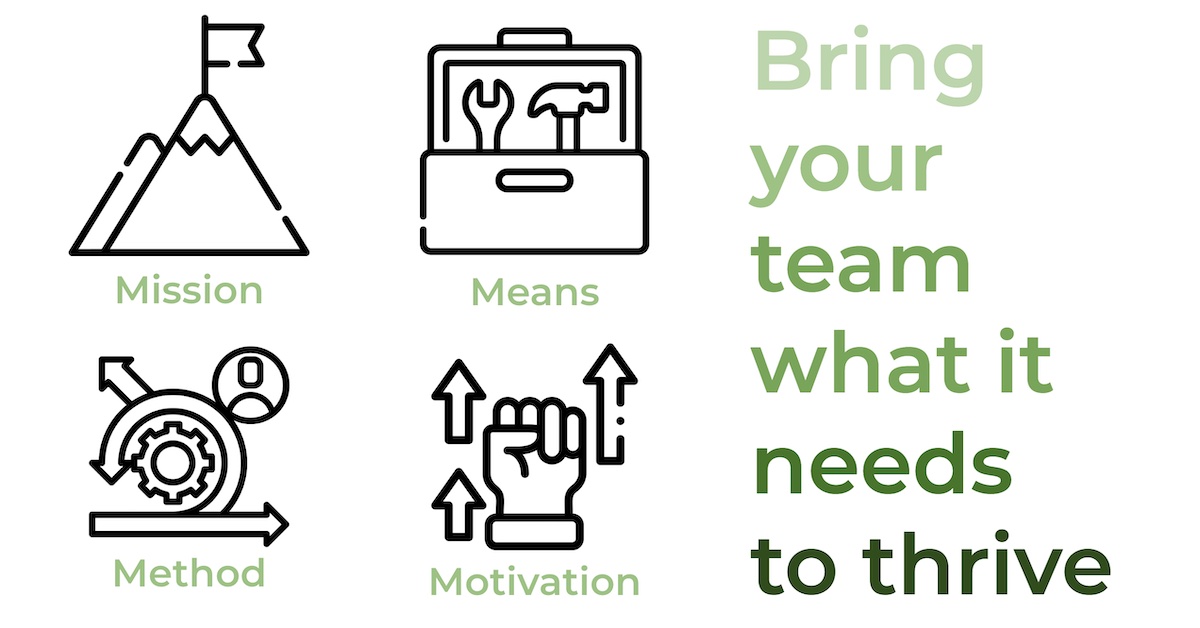
Here’s some advice for Engineering Managers and Team Leads who are looking to build thriving, flow-state teams. Go through the four Ms and check that the team has enough of each one to be healthy and growing.
1. Mission
All teams have a Mission. A group of individuals doing separate work does not make a functioning unit-of-delivery. To become a team, they need a clear, collective goal that the team can share and build towards together.
A Mission is more than a grouping of work-to-be-done or problems to be solved. It should set the stage, and define the purpose of the team, aligning the team’s thinking, planning and delivery.
The Mission should also function to constrain the team’s choices towards the most positive outcomes. When things get tough, it can be used to select the right priorities. In a more general sense it can help bring focus to what’s important, and to minimise distractions.
Find a North Star
Writing a North Star statement is a great way of defining your team’s mission. Think and understand what and who’s need you are meeting. What change could the team bring forth that would radically solve a big problem. If you can measure it, all the better.
Ensure it’s not too tied up with a single strategy or solution; As Jeroen Bolluijt puts it as “Metaphorically speaking, your north star is a fixed destination that you are trying to reach as the world changes around you.”
Humans need something challenging to collaborate around. Make it big and ambitious.
2. Method
Valuable working software does not appear by magic. Teams need to work together: to find communication and coordination points; to share learning and frustrations; and find better ways to get the work done. Without a working Method, the team can fail to align and not operate as a learning unit.
Bring to the team what it needs. Turn the Mission into value-focused work, and turn that work into key useful learning. Add process and procedure where it helps, but let the team find its way where it can.
Get things done and make learning happen.
I favour discovery focused ways-of-working that get the team building, measuring, and learning from the get-go. As Woody Zuill says “It is in the doing of the work that we discover the work that we must do. Doing exposes reality.”
That generally means opportunities to chat and collaborate daily. I also like a simple Kanban-ish way of getting a whole-team view of work-in-progress.
You don’t need to reinvent the wheel, but you likely need to select what suits the team and situation. My advice is to stay lightweight, keep it team centred, and produce working software as frequently as possible.
Ensure Feedback drives Process
Reflective practices should drive ways-of-working as well as the work that gets done. Every team should be taking time to regularly check-in and adjust how they work together. Ensure the team has a decent chunk of time to retrospect every week or two.
Some teams will arrive with experience of learning as they go, others will find this unsettling and may want to be told what to do. Ask the team how they know how they want to work and help them assess if it’s working. You may need to provide safety, and structure the work as they find their feet.
3. Means
A team with the Means to get the job done, is a team setup for success.
A team that can deliver a flow of value needs to have all the skills that are in regular use to create and ship useful code and features. Without these they will flounder, block, or produce compromised solutions.
Teams also should have the means to deliver the value to the user. They should not regularly wait for permission to ship. Some teams become Cloud Native, others rely on a paved path provided by an internal platform squad. With either, the ability and responsibility to ship is in the team’s hands.
Ask and observe
Use your experience to spot what the team is going to need to help them get it. Challenge the team to ask, and to find, or build what it needs.
Spot capability gaps and ensure the team is able to fill them though training or staffing. Spot common blockers. Push for budget for tooling, and seek ways for the team to not wait to ship.
4. Motivation
Even with the right Means and great reflective Method, ambitious Missions are always challenging. Your team is going to need to be Motivated to keep going when things get tough. Ensure the team has the Will Power and Way Power to keep trucking.
Gumption is Will Power; the spirit and energy to push through problems. This can come from individuals, or it can be driven through the desire to see the mission complete or solve a problem. Incentives can help, but often only in the short term.
Seeing options and paths forward is Way Power. Not everyone in the team needs this skill, but all will benefit from knowing that there are options on the table that move towards the team’s goals.
Thread the team together
Your job is to bring space and safety; to discover what makes each individual motivated and work out how to thread them together. You’ll also need to ensure that the team can see paths forward, and if not, help them find them.
It can be as simple as helping the team find joy in the work they do, finding out what makes them happy, and working with them on how to bring that into the team groove.
Could any part of the job be better than that?
 10x team